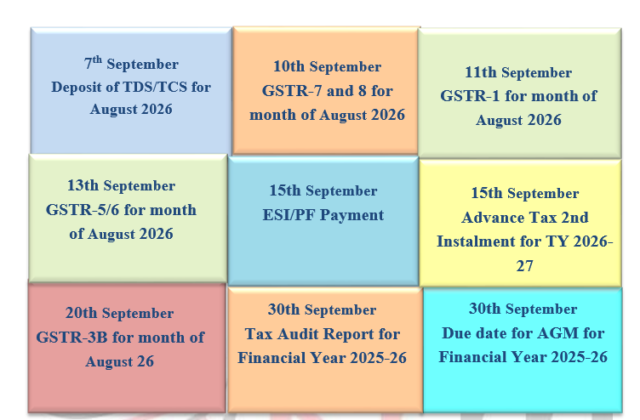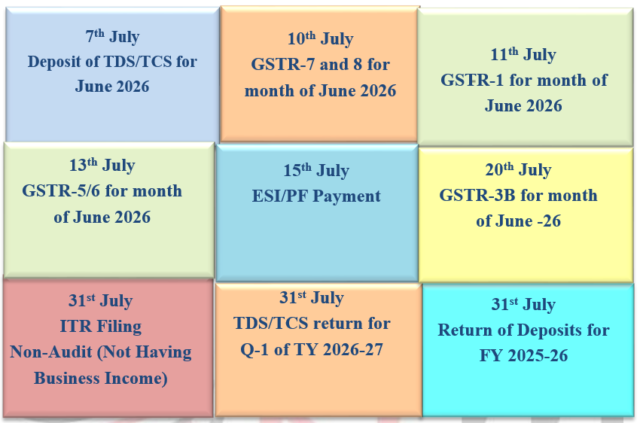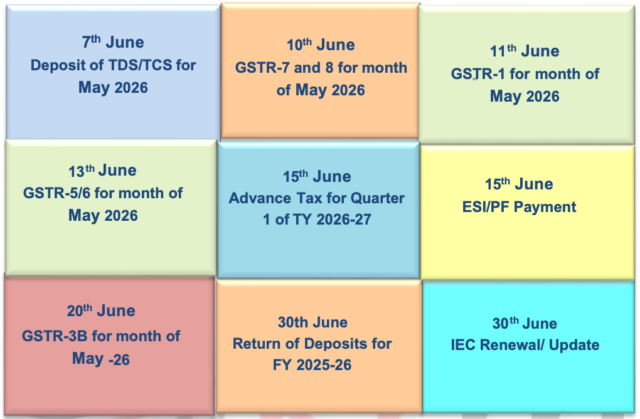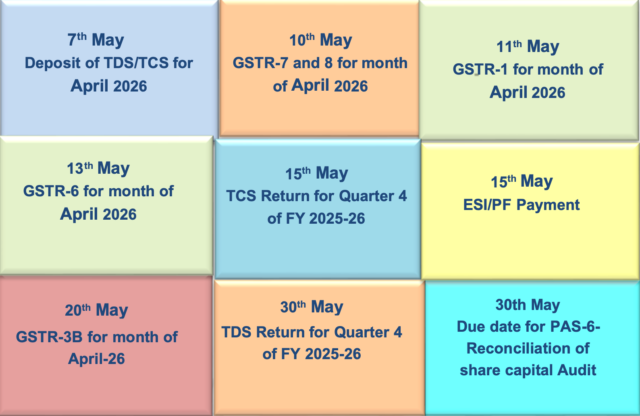

Executive Summary
Income Tax
- Extension of Due Date for furnishing the Tax Audit Report and Income Tax Return of persons who are subject to audit u/s 139 of the Income Tax Act, 1961.
- Section 508 of the Income-Tax Act, 2025 – Obligation to furnish statement of financial transaction or reportable account- format, procedure and guidelines for submission of statement of financial transactions (SFT-2517) for depository transactions under section 508, read with sub-rule (6) of rule 237 of the income-tax rules. 2026
Goods And Service Tax (GST)
- No. 473/12/2026-LC, Dated 21.09.2026 – Draft Warehousing Operations Regulations, 2026
- GSTN Advisory No. 672, Dated 19.09.2026 – emSigner Version 3.3 for New DSC Tokens
- GSTN Advisory No. 671, Dated 07.09.2026 – Filing of Appeals Against NIL/Zero Demand Orders
Companies Act 2013/ Other Laws
- MCA Cautions Stakeholders Against Unauthorised “MCA Signals” SMS Messages
- MCA Advisory on Nidhi Companies – NDH-4 Compliance Reiterated
- Extension of Accredited Investor Compliance Timeline for Angel Funds
- Ease of Regulatory Compliance for FPIs Investing Only in Government Securities
- Review of Position Limits and Penalty Provisions for Commodity Derivatives
- Withdrawal of Inoperative FEMA Circulars
- Strengthening Safeguards in the Insolvency Resolution Process for Personal Guarantors to Corporate Debtors

- THE FOREIGN ASSETS OF SMALL TAXPAYERS DISCLOSURE SCHEME, 2026 (CHAPTER IV, SECTIONS 130 TO 144 OF THE FINANCE ACT, 2026, READ WITH THE FOREIGN ASSETS OF SMALL TAXPAYERS – DISCLOSURE SCHEME RULES, 2026), DATED 14-08-2026
Foreign Assets of Small Taxpayers – Disclosure Scheme, 2026 is a one-time voluntary disclosure scheme contained in Chapter IV (sections 130 to 144) of the Finance Act, 2026. It enables eligible taxpayers to declare certain undisclosed foreign assets, undisclosed foreign income, or undeclared foreign assets, on payment of a specified tax or fee.
The Scheme comes into force on 16th August 2026. The last date has been fixed as 31st December 2026. No declaration can be filed after this date
An “assessee” eligible under the scheme is one —
- who is resident in India, (as per section 6 of the Income-tax Act, 1961), in the relevant previous year; or
- who is a non-resident, or resident but not ordinarily resident (RNOR), [as per section 6(6) of the Income-tax Act, 1961], in the relevant previous year, but was resident in India either-
- in the previous year to which the undisclosed foreign income under section 4 of the Black Money Act, 2015 relates, or
- in the previous year in which the undisclosed asset located outside India was acquired.
A person being a non-resident but was resident in India either
- in the year to which the undisclosed income relates; or
- in the year in which the undisclosed asset was acquired can make a declaration.
A declaration may be made where the assessee —
- has failed to furnish a return under section 139 of the Income-tax Act, 1961; or
- has failed to disclose the asset or income in return furnished before the scheme commenced; or
- Such assets or income has escaped assessment within the meaning of section 147 of the Income-tax Act, 1961.
There are two broad categories of declaration —
- an undisclosed asset located outside India or undisclosed foreign income which was not offered to tax. [Section 133 – Table: Sl. No. 1]
- an asset located outside India, which was already offered to tax or was acquired when the assessee was a non-resident, but not declared in the relevant Schedule of the return.[Section 133 – Table: Sl. No. 2]

- No. 473/12/2026-LC, Dated 21.09.2026 – Draft Warehousing Operations Regulations, 2026
CBIC has invited stakeholder comments on the Draft Warehousing Operations Regulations, 2026, with a 15-day period for submission of suggestions.
Key Highlights:
- Comments invited on the proposed warehousing regulations.
- Suggestions to be submitted in the prescribed format within 15 days.
- Covers proposed operational and compliance requirements for customs warehousing.
Impact:
Warehousing operators, importers, exporters and customs stakeholders should review the draft and submit relevant suggestions within the prescribed timeline.
- GSTN Advisory No. 672, Dated 19.09.2026 – emSigner Version 3.3 for New DSC Tokens
GSTN has introduced emSigner Version 3.3 for compatibility with new DSC tokens issued from 21.09.2026.
Key Highlights:
- New DSC tokens issued from 21.09.2026 require emSigner v3.3.
- Existing valid DSCs can continue to be used until expiry.
- Updated emSigner is required for smooth DSC-based GST activities.
Impact:
Taxpayers obtaining new DSC tokens should install emSigner v3.3 to avoid difficulties in GST portal filings and other DSC-based activities
- GSTN Advisory No. 671, Dated 07.09.2026 – Filing of Appeals Against NIL/Zero Demand Orders
GSTN has enabled Form GST APL-01 filing for specified cases involving NIL or Zero demand orders, where the taxpayer continues to dispute the underlying tax liability.
Key Highlights:
- Portal restriction on filing APL-01 against NIL/Zero demand orders removed for eligible cases.
- Applicable where payment was made before issuance of the demand order.
- Taxpayers can now pursue the appellate remedy through Form GST APL-01.
Impact:
Provides taxpayers an avenue to challenge the underlying tax liability even where the demand reflected in the order is NIL/Zero.

- MCA Cautions Stakeholders Against Unauthorised “MCA Signals” SMS Messages
The Ministry of Corporate Affairs cautioned stakeholders about unauthorised SMS messages referring to “MCA Signals” and directing recipients to an external website to view company reports. MCA advised stakeholders to verify the authenticity of communications and not to rely on such unauthorised messages.
Companies and professionals should rely only on communications and services available through the official MCA portal and remain alert to fraudulent communications.
- MCA Advisory on Nidhi Companies – NDH-4 Compliance Reiterated
MCA issued an advisory cautioning the public regarding Nidhi Companies, particularly companies promising unusually high returns. MCA reiterated that companies desirous of functioning as Nidhis are required to file Form NDH-4 for declaration/recognition as a Nidhi, as applicable.
MCA also stated that deposits accepted by Nidhi Companies are not insured by DICGC and advised the public to independently verify whether a company has been declared as a Nidhi by the Central Government.
- Extension of Accredited Investor Compliance Timeline for Angel Funds
SEBI extended the timeline for existing Angel Funds registered on or before 10 September 2025 to comply with the Accredited Investor mandate. The deadline has been extended from 8 September 2026 to 31 March 2027. During the extended transition period, the existing limit of 200 non-Accredited Investors continues to apply.
- Ease of Regulatory Compliances for FPIs Investing Only in Government Securities
On September 7, 2026, SEBI issued a circular aimed at easing regulatory compliances for Foreign Portfolio Investors (FPIs) investing exclusively in Government Securities. Under the revised framework, such FPIs are exempted from furnishing investor group details, thereby reducing their reporting and compliance requirements. The measure is intended to simplify the regulatory process for FPIs whose investments are limited to Government Securities. The circular is effective immediately and requires the relevant intermediaries, including custodians, depositories and Designated Depository Participants, to make necessary system and process changes.
- Review of Position Limits and Penalty Provisions for Commodity Derivatives
On September 9, 2026, SEBI revised the framework governing client-level position limits and penalties for breaches in the commodity derivatives segment. The revised framework introduces different position limits for Broad, Narrow and Sensitive commodities, at 2%, 1% and 0.5%, respectively. The circular also provides a revised mechanism for penalties in cases where prescribed position limits are breached. Clients are required to reduce excess positions within the prescribed timeline, failing which the concerned exchange may undertake square-off of the excess position. The revised framework is aimed at strengthening risk management and promoting orderly trading in the commodity derivatives market.
- Withdrawal of Inoperative FEMA Circulars
On September 8, 2026, the Reserve Bank of India (RBI) issued a circular reviewing the circulars issued under the Foreign Exchange Management Act, 1999 (FEMA). As part of its ongoing initiative to rationalise and simplify the FEMA regulatory framework, RBI withdrew seven circulars that had become inoperative due to subsequent amendments, redundancy, overlap or supersession by newer regulatory directions. The measure is intended to make the FEMA framework more streamlined and reduce reliance on outdated regulatory instructions.
- Strengthening Safeguards in the Insolvency Resolution Process for Personal Guarantors to Corporate Debtors
On September 12, 2026, IBBI published a Discussion Paper titled “Strengthening safeguards in the Insolvency Resolution Process for Personal Guarantors to Corporate Debtors.” The paper examines areas where the existing framework for insolvency resolution of personal guarantors may require additional safeguards. It considers measures to strengthen creditor protection, transparency and procedural safeguards during the resolution process involving personal guarantors. The discussion paper forms part of IBBI’s ongoing review of the insolvency framework and seeks stakeholder views on possible regulatory improvements. As it is a discussion paper, the proposals contained in it should be distinguished from provisions that have already been made effective through regulations or circulars.

Disclaimer Information in this note is intended to provide only a general update of the subjects covered. It is not intended to be a substitute for detailed research or the exercise of professional judgment. KNM accepts no responsibility for loss arising from any action taken or not taken by anyone using this publication. Updates for the period 30.09.2026